A Daughter Remembers
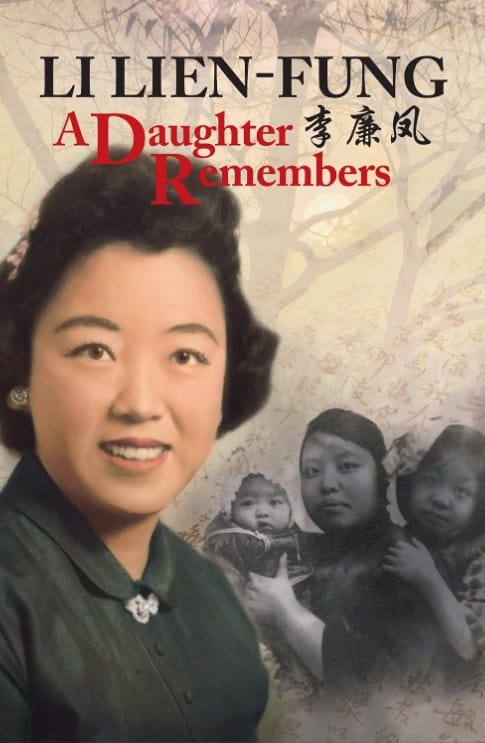

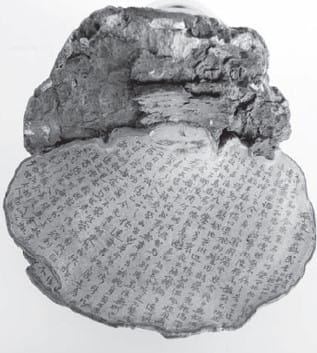
In the autumn of 1923 Mr Li Kuo Ching 李国钦was walking in the woods in Haines Falls (Catskill Park upstate New York), and he found 2 灵芝 – that was the inspiration for the author’s Chinese book 两片灵芝, this book was translated from the Chinese text.
The origin of 两片灵芝:
In 1998, Marjorie suddenly sent me a package. She explained that after Grace had died, the house at Glen Cove had not been occupied, but now that it was to be sold, she and her daughter Lisa had gone to the cellar to clean up whatever old junk there was before the house was taken over by the new owner. Among great piles of litter, she found two pieces of lingzhi, with Chinese characters inscribed on them. Since she did not read Chinese, she thought I might be interested, so she mailed them to me.
Each of those two pieces of lingzhi was about the size of a small book. There were tiny words etched on the surface of each fungus. Upon close inspection, on the corner of one of them, were the words “Haines Fall, Catskill, N.Y. Sept. 9, 1923.” Just one glance, and I recognized my father’s handwriting.
Below those brief words in English were lines and lines of Chinese, also in my father’s handwriting. I smiled when I saw them. It was probably on one of his hiking trips to the Mountains that he had found the lingzhi, pried them off the trees and then carefully etched in the words, thinking what a clever and charming idea it would be to bring them home as a souvenir.
That was what I thought at first, but after I examined it again, I recognized it was a copy of Li Ling’s1 letter titled “An Answer to Su Wu.”
The making of xiucai (秀才) :
The only thing about becoming a carpenter was that he had to know how to hold a brush-pen so that he could draw decent pictures of chairs, tables and cabinets. So my Zeng-zufu (Li Kuo Ching’s father) wanted to send this son to the village school. But he had no money. What was he to do? Where could one find a teacher who would not ask for tuition?
Granddad had four elder brothers who toiled in the fields along with their father, so he could be spared to study at his leisure. And since his teacher never got tired of vegetables and eggs, he could continue to be properly tutored until he was ten, old enough for him to be taken to the city to be a carpenter’s apprentice. With that in mind, Zeng-zufu went to the teacher to bid him goodbye.
The teacher was a traditional scholar. Because he himself never got past the title of juren12 in the Imperial Examination, he had hoped to be able to teach a student who could become one. He found that, although Granddad came from an illiterate family, the ten-year-old boy was rather gifted and might just someday fulfill his wish, so he was reluctant to let the boy quit school.
He said to Zeng-zufu: “Let your son study a few years more with me. He can then take the Imperial Examination and perhaps become a government official. It would bring glory and wealth to your family. Wouldn’t that be better than being a carpenter?”
Zeng-zufu’s answer was cold and simple. “Such fortune is not for the likes of us.”
The teacher tried to persuade him, but Zeng-zufu remained adamant. Finding Zeng-zufu’s stubbornness beyond reason, the teacher changed his tactic and suggested that his student, my Granddad, study accounting. Surely, he said, an accountant earned more than a carpenter. Zeng-zufu puffed on his pipe for a long while then finally agreed.
To prepare Granddad, the teacher took him, without telling Zeng-zufu, to try out all sorts of formal and informal Examinations. When the time was finally ripe he and Granddad went to town, registered themselves for the city-level examination, took it, and quietly returned to the village to await results.
I don’t believe this part of the story. Things couldn’t have been so simple. A penniless teacher could not have afforded to bring an equally penniless pupil to town, and not just once but several times. Besides, without parental approval, how could he have registered the son? But, whether I believe it or not, this was what I was told. The story was that, without Zeng-zufu’s permission, my Granddad passed the Examination and became a xiucai.
How 5th uncle learned geometry :
One day, in 1893, when he was about sixteen or seventeen, Fifth Uncle went with his father to the city to sell their vegetables. As was their habit, they stopped on the way home at a second-hand book stall. Amidst the tattered books, he came upon one the likes of which he had never seen before. It had a hard cover and the papers inside were stiff and shiny, unlike the Chinese books whose pages, made of rice paper, were so soft that they might be rolled into cylinders. Even more astonishing to Fifth Uncle was its contents. Not only were the pages printed with little wriggly worms, but the book also had circles, squares, triangles and many incomprehensible symbols. His curiosity aroused, Fifth Uncle stood by the book stall leafing through the book slowly, not knowing that it was to be his first geometry text.
As he stood there, transfixed, with his newfound book in his hand, the bookseller turned to Granddad with an ingratiating smile. “That was left behind by a foreign missionary,” he said. “He bought it for his son, but they left last month and his servants sold it to me. Look at your son! See how mesmerized he is by it. Why don’t you buy it for him?”
Granddad had already noticed the hungry look in Fifth Uncle’s eyes, but he still answered as if he didn’t care. “Only a fool will buy a book he can’t read. Look, since nobody knows how to read it, you may as well give it to my son for free, and I will buy from you fifty sheets of writing paper. If not, I will go somewhere else.”
If you find the reading interesting so far, you may want to download here: