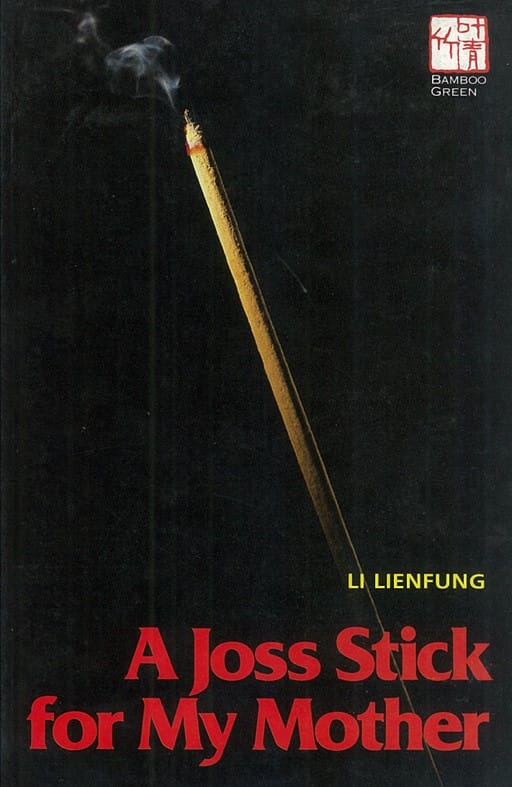
A Joss Stick for My Mother
This is the follow-up of Bamboo Green articles that appeared in the Straits Times from January 1980 to April 1981.
Introduction by Ho Minfong (Author’s Daughter)
As far back as I can remember, there has always been a light in my mother's study at night. My bedroom adjoined her study, and after she had tucked me in, she would leave the door ajar, so that I could see her at her desk while I was drifting off to sleep. Sometimes she would play Chinese chess with my father, or she would nibble at salted duck gizzard and sew, or perhaps sip at her Bamboo Green wine and read Tang poetry. Mostly, though, she wrote.
What she wrote about I do not know. It held a quality of the mysterious because it was done in quiet solitude, after we children were supposed to be asleep. Some poetry, may be, or else something quite pedantic, like her stock market accounts or laboratory reports. And of course, she wrote letters to her mother in China.
She had left her mother at sixteen, at the height of the Sino-Japanese War, to join her father in America and to study at a girls' college there. It was to be a turning point in her life. A tearful goodbye at the harbour, a three-week journey on an ocean liner, and finally a peroxide blonde waitress in San Francisco slapping a hamburger before her with a nasal, "Here, honey!" — and my mother was totally, irrevocably, desperately homesick.
She has not stopped yearning for China since.
My mother spent the next ten years of her life in America, in the process acquiring an American accent and a Singaporean husband (in that order, I think). Except for a brief visit on her way from New York to Thailand in 1948, she did not set foot in China for almost forty years.
And yet, she stubbornly retains a deep sense of "Chinese-ness”.
For the overseas Chinese, China means so many things: ancestral roots, national pride, cultural identity. There is a fierce pride and a vague shame; a sense of belonging and an alienation. China is a homeland which has become a foreign country.
To her children, all born outside of China (in Burma, Hongkong and Thailand respectively), my mother tried very hard to impart a sense of what it meant to be Chinese.
And what was it? Red packets at New Year, paper lanterns at Mid-Autumn Festival, bowing before the family altar, smoked duck and steamed bread — these were the tangible things, the form without enough content. For content, my mother apparently believed that one had to master the Chinese language.But the mere nomenclature labelling relatives, food and furniture in Chinese was not enough. We had to learn classical Chinese. And so, on weekends when our neighbours were playing dodgeball or netting shrimps in the pond, we sat memorizing Tang poems. There are three hundred of them in the standard anthology, and my brother and I had barely dented the surface before we felt that, if this was Chinese, it was a foreign language.
What, after all, is autumn? Why do wild geese fly south every year, and what does frost look like? Tang poetry seemed full of such things, and if chanted in the rhythmic cadences in which they were written, they sounded beautiful. Beautiful but foreign.
It was like being made to recite William Wordsworth's "The Daffodils", in school, without ever having seen a single one of those yellow (purple? pink? blue?) flowers.
Chinese was as foreign a language to us as English.
On the other hand, we didn't know the Chinese word for guava, or tamarind, or iguana. Such things surrounded us, as children of the tropics, every day. They formed the natural fabric of which our world was made — and yet there was no easy Chinese word for them.
There is dysjunction in the Chinese language as it existed for me. It didn't have words for many of the familiar things around us, yet it was full of words for things I had never laid eyes upon. Whether we like it or not, many of us in Singapore have inherited the two linguistic mainstreams of the world, and must make use of both to feel complete.
No wonder then that my mother writes her Bamboo Green articles in both English and Chinese. Bilingualism for people like her is not an option; it is an emotional necessity.
Since she started writing for the Bamboo Green column in the Straits Times four years ago, she has not missed a single week. Often she has to write in what can be described euphemistically as distracting conditions. Her study, where she does her writing, is for all intents and purposes the family room. Invariably there is a TV blaring, several grandchildren underfoot or climbing up the bookshelves, friends of the family dropping by for a plate of fried rice and a chat, and the phone ringing. Doggedly, my mother is bent over her new Apple computer (acquired, she claims, with the fees from her Bamboo Green articles).
Oblivious to the general level of noise around her, she types quietly away, distracted only when a grandchild or two crawls within punching distance of the DELETE key on the computer. Strangely enough, she never frowns in concentration, and she doesn't seem to need the headphones that she got as a birthday present, to block out the noise. Instead, she smiles to herself and once in a while breaks out into a loud laugh. She is enjoying herself.
Li Lienfung writes her Bamboo Green stories not just because she is dedicated to promoting bilingualism, but because she is having fun, too.
I think her own mother, my grandmother, would approve. Popo never spoke anything but her Hunanese dialect all her life, but apparently she read everything from The Brothers Karamazov to Little Women in translation. She was one of the first women in her province to have an education instead of bound feet to recommend her during her matchmaking. Yet she was soft-spoken and shy. (That she placed first in her graduating class and didn't turn up for the prize award ceremony because she was too shy, has become a part of family mythology.) I do not remember much of Popo. She was bulky and soft and wore dark blue clothes. And she loved to tell stories.
In everything that my mother writes, there is the spirit of her own mother unobtrusively peeping over her shoulder. She used to write, late at night under her desk-lamp, long letters to her mother in China. Now that Popo is dead, my mother writes her Bamboo Green articles, trying perhaps to keep alive stories, memories and thoughts that would otherwise disappear.
My mother maintains, rather fancifully, that there are such things as 'genetic memory which transmits a sense of one's historical past along with one's biological characteristics. (Then why did we have to sweat over memorizing Tang poetry, if it would all be transferred over effortlessly in DNA anyway? My mother said the question was childish.)
Genetic memory or no, I too feel that my mother is Chinese because her mother was Chinese. It is as simple, and as complex, as that. And, by the same illogic, I am Chinese because Mama is Chinese.
Yes, I have a daughter now. Her name is Shao Fung, or Dawn Maple. In the pre-dawn hours, when even my mother has gone to sleep, I breastfeed little Shao Fung in my mother's study. There is a nightlight there, illuminating a faded photograph of my grandmother. My daughter grasps my thumb and suckles, gazing at the tiny spotlight where her greatgrandmother smiles vaguely into the darkness. Perhaps they communicate wordlessly. Or perhaps they even communicate in Chinese.
If you find the reading interesting so far, you may want to download here: